
Bristol County Release Mugshot Records
A booking photograph records appearance during an agency's intake process. It does not show the final disposition, guilt, current custody, or the date a person was released. In Bristol County, BCSO does not publish a roster photo, release gallery, or named booking feed. A photo may remain in an agency file after the person leaves, but its existence and its public availability are separate questions.
Massachusetts law is nuanced. Under 803 CMR 2.00, a standalone booking photograph is excluded from CORI. A booking sheet or larger compilation that links the image with identifiable criminal-history information can still contain CORI. The Massachusetts Supreme Judicial Court's Boston Globe Media Partners v. DCJIS decision rejected categorical CORI withholding for the records at issue, while leaving privacy, investigatory, sealing, juvenile, and other case-specific limits in place.
The result is a targeted request process, not a universal right to every Bristol County mugshot. Ask for the image alone, identify the booking and custodian, and request any segregable nonexempt portion. If access is denied, ask for the written legal basis. A photograph must always be read with the originating agency, booking date, and later court record.
Find Bristol County Booking Photos
The correct channel depends on who created the image and where the person went. A city or town police department may hold an arrest image that predates BCSO intake. BCSO may hold a jail booking photo. MA DOC has separate records if the person entered state prison. None of those routes should be confused with a Bristol County public gallery, because no such official gallery was found.
| Channel | Has a public photo? | How to access |
|---|---|---|
| BCSO roster or release feed | No | No named roster, release list, archive, or photo feed is published |
| BCSO mobile app | No | No official inmate lookup or mugshot app was found |
| BCSO record request | Possible, case-specific | Request a specified standalone photograph and ask for segregable production |
| Arresting police department | Possible, case-specific | Contact that department's records access officer if it created the image |
| MA DOC or VINELink | Not promised | VINELink is a status locator, not an official DOC photo gallery |
| Public registry | Only for qualifying entries | Level 2 or 3 registry pages may include a registry photo under their rules |
| Official press or news report | Sometimes | Use only as evidence that the image was published, not as release proof |
The federal BOP locator likewise shows status fields rather than an ordinary released-person mugshot. Detailed federal image records follow federal access rules. Commercial photo sites are not reliable custody evidence and receive no links here.
Bristol County Sheriff Publishes No Mugshots
BCSO's practical publication policy is nonpublication. Its homepage lists only aggregate custody totals. It offers no named inmate roster, 24-hour or 72-hour release feed, mugshot gallery, or official lookup app. The sheriff's Facebook, Instagram, LinkedIn, and Vimeo links are agency communications channels, not booking-photo databases. A payment or communications vendor should not be substituted for an official sheriff app.
The BCSO homepage source is shown below because it documents the aggregate format and absence of person-level photographs.
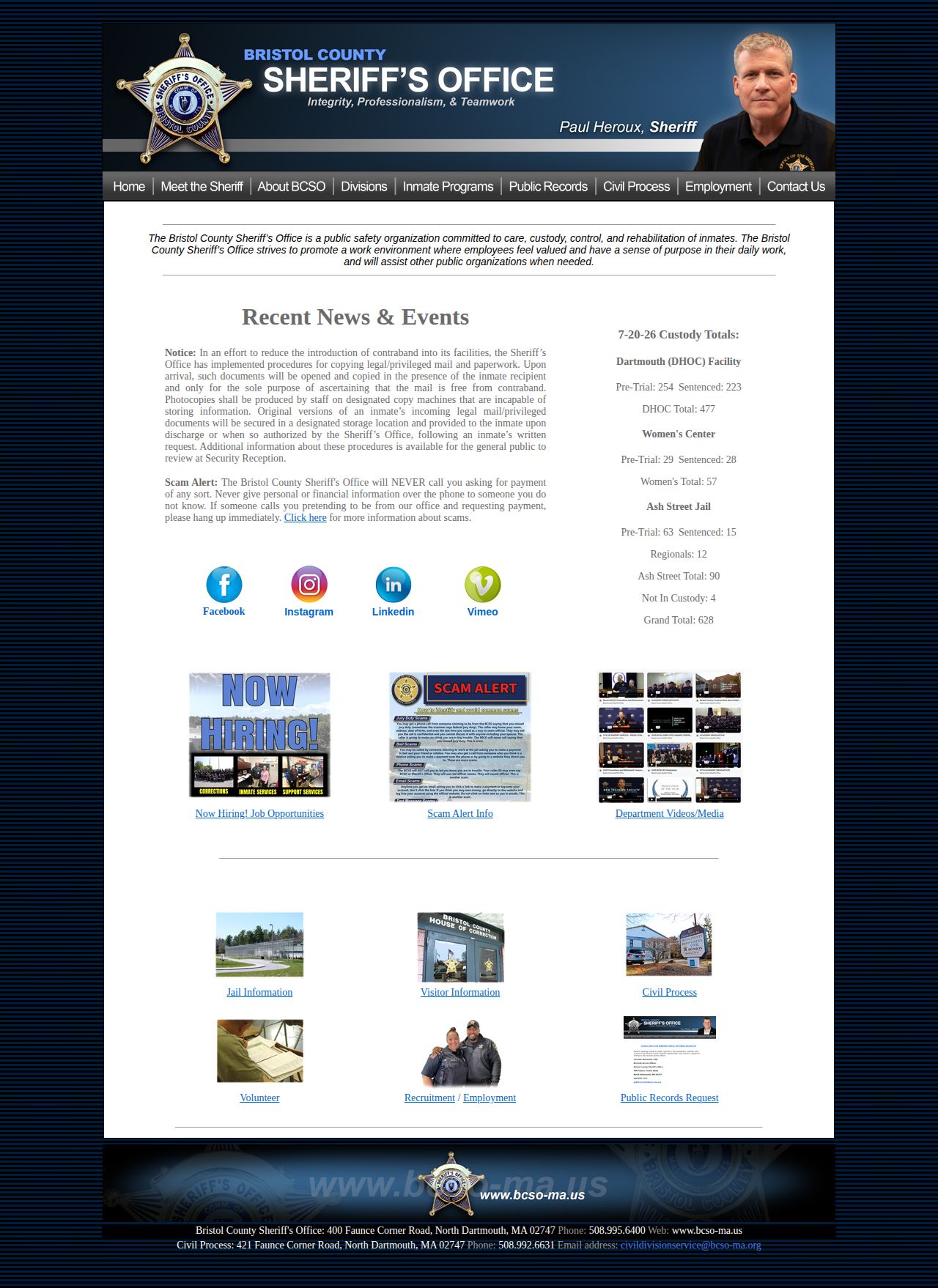
The “Not In Custody” figure is not a release-photo index. It cannot be used to identify a person or connect a booking image to a release.
A current photo also cannot be inferred from BCSO's facility descriptions. The official facilities page describes the main jail, Women's Center, Modular Building, and Ash Street functions, but it is not a person search. The Bristol County same-day release check explains the no-feed custody fallback without promising photos.
Request a Bristol County Booking Photograph
The BCSO public-record request page identifies the office and accepted request routes. Massachusetts public-record law permits a request by hand, mail, or email to the records access officer. A request must reasonably describe an existing record. For a booking photo, specificity helps separate the image from the wider custody file that may contain protected information.
- Name the agency believed to hold the photo. Use the arresting police department if it created the first image, or BCSO for a county jail booking image.
- Give the full subject name, booking or arrest date, facility, and booking number if known. Avoid asking for unrelated file material.
- Request the standalone booking photograph and any segregable nonexempt portion. State that a photo alone is the item sought.
- Ask for electronic delivery when available. BCSO publishes no flat booking-photo fee; actual reproduction cost or permitted labor charges may apply.
- Keep the written response. If the custodian withholds the image, request the cited exemption and appeal instructions.
The agency must produce or send the required written response within ten business days. That is a response deadline, not a guarantee that the photo will be delivered by then. State agencies ordinarily provide the first four labor hours without charge and may then assess permitted labor fees, while ordinary black-and-white paper copies are governed by the statewide fee rules.
The request page and BCSO's express CORI limit appear in the official records capture.
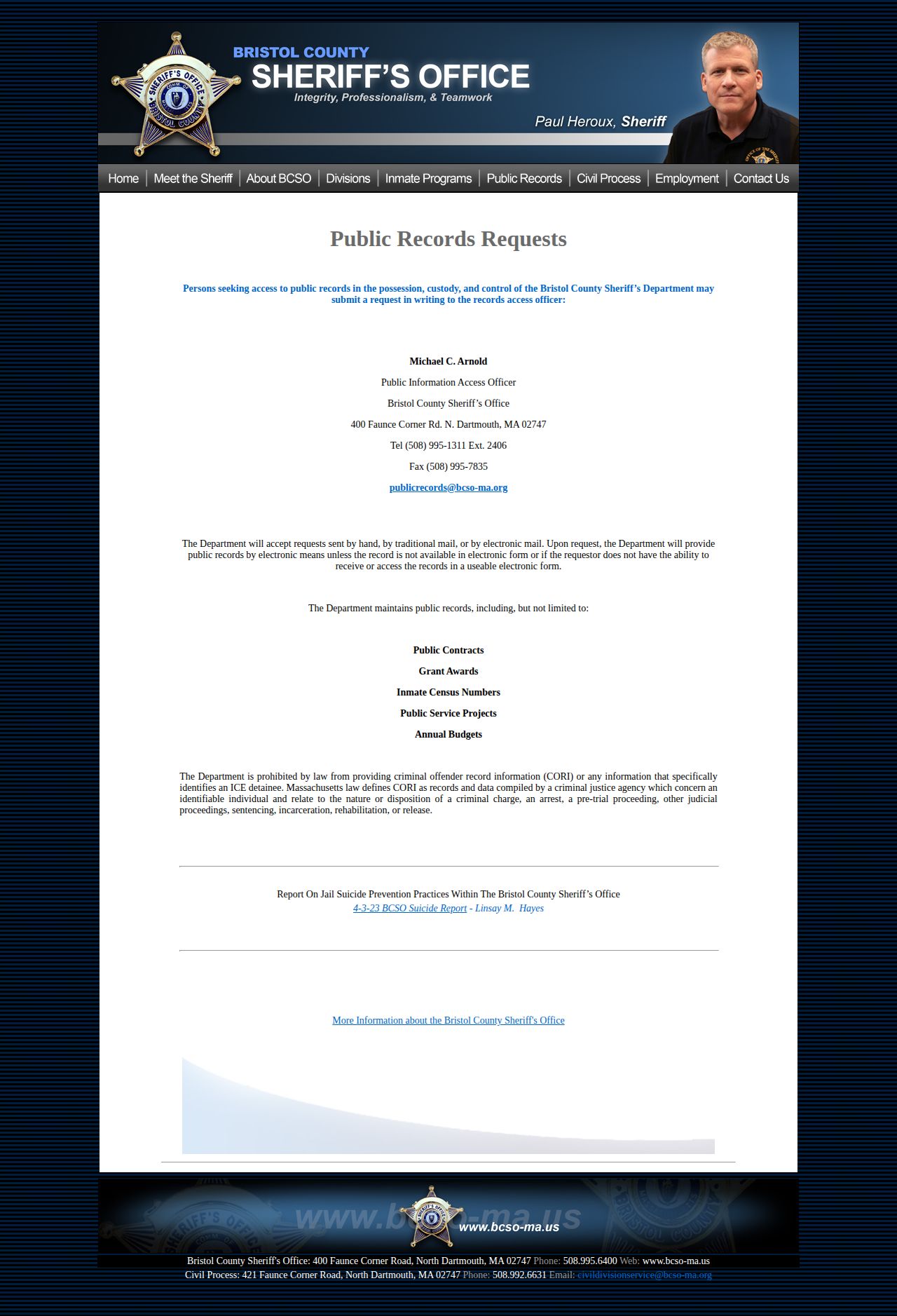
The capture supports a narrow photograph request. It does not mean BCSO will release a broader booking or release compilation.
Note: A custodian must consider segregable nonexempt material, but retention of a photograph does not itself require public disclosure.
Bristol County Mugshots Beyond BCSO
An arresting police department can be the correct photo custodian when its image was made before transfer to BCSO. Municipal retention and exemption analysis may differ from the sheriff's. Send a focused request to that department's records access officer and use the same booking date and incident identifiers. If the person later entered MA DOC, the official state locator instructions point to VINELink for status, but neither source promises a public DOC photograph.
The Massachusetts public sex-offender registry is a narrow, purpose-specific source. A qualifying Level 2 or Level 3 entry may display a photo. That image reflects registry status and is not a general booking mugshot service. It also does not prove the date or reason for the person's most recent release. Level 1 and some older Level 2 information are not part of the same public online display.
An official agency press release or a reputable news report may carry an arrest image. Such a publication confirms only that the image appeared there. It does not replace the final court disposition or a custody record. Commercial mugshot aggregators should not be used as proof. Their images may remain after dismissal, acquittal, sealing, expungement, transfer, or release, and they often omit later outcomes.
Bristol County Mugshot Sealing and Removal
Sealing limits public access to a criminal record under Massachusetts law. Expungement is narrower and can remove qualifying records through a statutory process. Neither result should be reduced to an automatic promise that every copy of a photograph disappears from every custodian or prior publication. Use the official court process, obtain the order, and send it to the agency or publisher that controls the copy in question.
No Massachusetts statute specifically regulating mugshot websites' pay-to-remove charges was found in the current research. M.G.L. c.214, §3A supplies a general remedy for some unauthorized advertising or trade uses of a person's name or picture, but it is not a specific mugshot takedown law. Privacy, sealing, expungement, defamation, consumer law, and a publisher's own policy can raise separate issues. An official removal request should identify the image, the source URL or record, the legal change, and the relief sought.
A booking photo must not be captioned as a “released inmate” unless a separate source confirms release. A dignity-forward description states the originating agency and date, notes that the image marks a booking, and avoids claiming conviction or present custody.
How Long Bristol County Mugshots Remain
The statewide records schedule adds an important local detail. Sheriff-series item J10-26 calls for inmate photographs to be kept for 10 years until superseded. House of Correction files have a longer 25-year-after-release retention rule. These periods explain why a Bristol County booking photo may still exist long after no public web entry can be found.
Retention is not the same as access. CORI, privacy, investigatory, juvenile, sealing, expungement, and other restrictions can still control release of the image. A records access officer must make a case-specific decision. When a custodian says the record no longer exists, asking which schedule item and authorized disposition applied can clarify the answer.
The official BCSO facility descriptions are shown below to help identify the likely county custodian and facility named in a request.
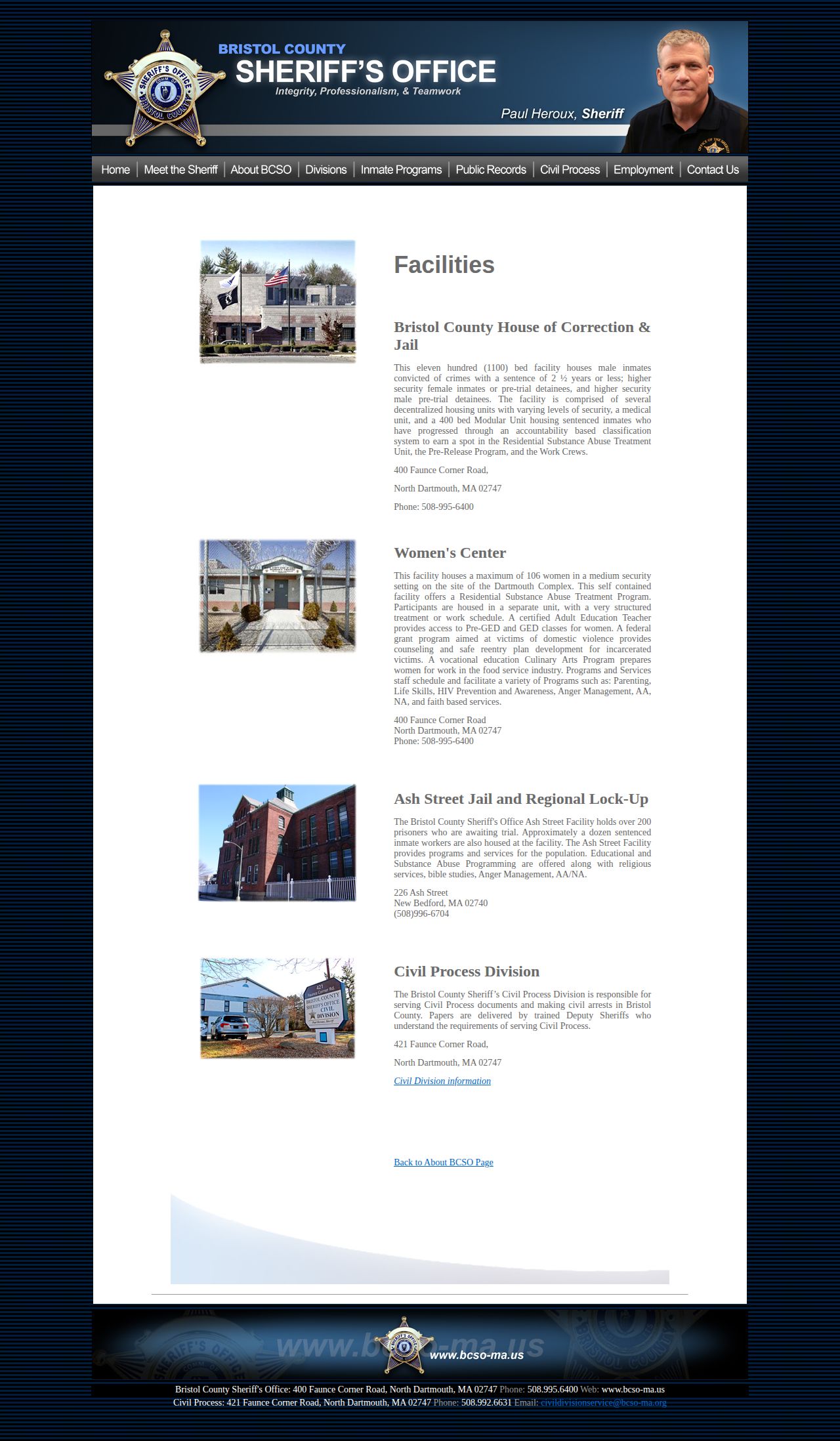
The facilities source helps narrow a request, but it does not display booking photographs or confirm which building created an image.
Confirm Bristol County Mugshot Context
Photo discovery and release verification are separate tasks. First identify the source image. Then use the court docket for charges, disposition, sentence, dismissal, or sealing status. Finally, use BCSO or a receiving agency to confirm whether the person left county custody, moved within the system, or transferred elsewhere.
- Booking photograph
- An intake image tied to an arrest or admission, not proof of guilt or current status.
- CORI
- Massachusetts criminal offender record information, which can include identifiable incarceration and release data.
- Sealing
- A legal limit on public access to an eligible record.
- Expungement
- A narrow statutory process for qualifying records, not a general deletion request.
The Bristol County release record process supplies the custody and court context that a photograph cannot. Keeping those sources separate prevents an old image from being mistaken for a current jail or release record.
When dates conflict, use the originating photo record for the booking date and the court or custody source for the later outcome. Do not infer one from the other.