
Bristol County 72-Hour Release Review
The Bristol County Sheriff's Office publishes no rolling 72-hour roster. There is no exact release-feed URL, filter, cadence, photo field, archive, or named retention window. The BCSO homepage provides only dated aggregate counts for its locations and a “Not In Custody” total. It cannot reveal whether any one person was released during the prior three days. Changes in those figures can also reflect admissions, movements between sheriff units, court transport, or transfers.
The three-day question must therefore be reconstructed from existing records. A regional detainee may leave Ash Street for court, receive bail or recognizance, move to Dartmouth, enter state or federal custody, or return to the community. A sentenced person can complete a house-of-correction term or be transferred. Each path produces different evidence. The docket shows the legal event. BCSO holds the custody transaction. A receiving authority may show the next status.
The official totals can be viewed in the BCSO aggregate source shown below.
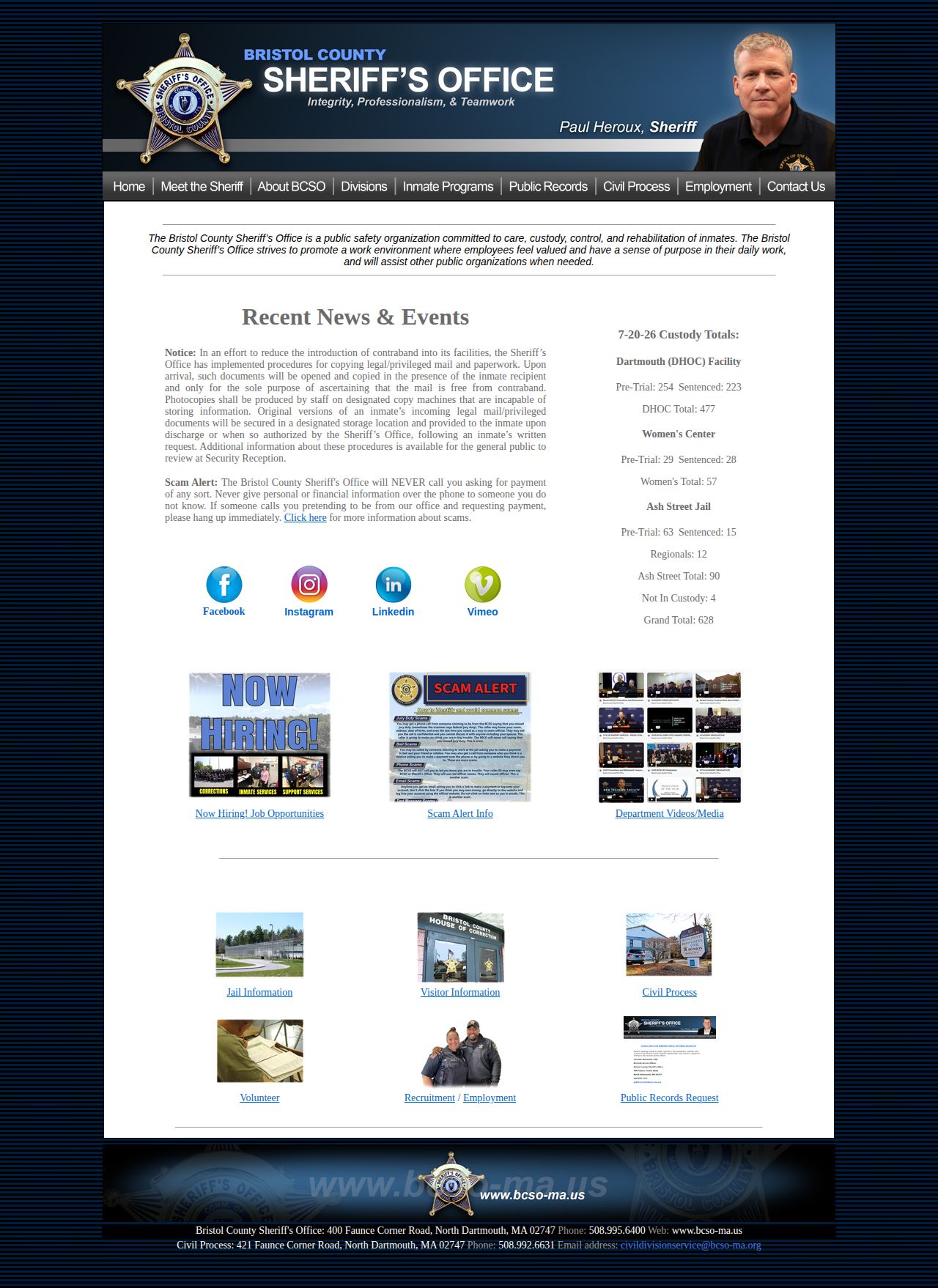
The capture documents what BCSO does publish. Its lack of names, dates, reasons, and photos is why a record-by-record review is required.
Trace Bristol County Three-Day Releases
Begin with a timeline, not a roster. Note the last confirmed facility, arresting town, likely court, and each date in the 72-hour span. Bristol criminal matters can run through District Courts in Attleboro, Fall River, New Bedford, or Taunton, and through Bristol Superior Court locations. Remote name search is not complete for every criminal matter. An exact docket number reduces ambiguity.
- Identify the last BCSO location. Ask whether it was Ash Street, the main Dartmouth jail, the Women's Center, or the Modular Building.
- Use the official court-docket instructions and MassCourts. Search the owning court and use the docket number when available.
- Read entries for bail, recognizance, dismissal, sentence, probation, remand, or transfer. Remand means the court ordered the person back into custody.
- Contact the clerk or use a courthouse public terminal if the remote criminal record is missing or incomplete.
- Ask BCSO whether the person remains in its system. For a record, describe the exact existing custody or release transaction sought.
- Follow any transfer into MA DOC, BOP, or ICE through that agency's locator. Do not use Massachusetts VINE for Bristol jail-only custody.
The court-search source is captured below. It shows why the court division, docket number, CAPTCHA, and clerk fallback matter in a Bristol County 72-hour release review.

A docket can confirm the judicial action, but it may not show the exact moment sheriff processing ended or the person's final destination.
Bristol County Three-Day Release Evidence
No official 72-hour page shows person-level fields. Instead, assemble only the lawfully available facts that answer the release question. Massachusetts release terminology includes community discharge, probation, parole, a transfer to another criminal-justice agency, a warrant, and statuses in which a person remains incarcerated. The destination is as important as the date.
| Evidence | What it can establish |
|---|---|
| Court and docket event | Bail, recognizance, dismissal, sentence, probation, remand, or another judicial order |
| BCSO custody transaction | Actual exit or transfer date, time, facility, and type when lawfully accessible |
| MA DOC VINE result | Participating state-custody status and a projected date when supplied |
| BOP locator result | Federal status and release date for covered federal records |
| ICE locator result | Current detention or limited recent-release coverage, not a full history |
| BCSO aggregate count | Operational totals only; never a named release |
Read compatible events together. A Bristol docket may show a sentence or release order while a later MA DOC entry shows admission elsewhere. That can mean the person left one custodian for another. It is not evidence of a return to the community.
Massachusetts also treats “remain incarcerated” as a possible result when one legal status closes and a new sentence begins. Death can appear as an administrative release type and must never be described as community release. For each Bristol County event, record the exact agency label and destination instead of shortening every outcome to “released.”
Note: “Not in custody” in one system does not rule out custody, supervision, or a warrant in another system.
Bristol County Weekend Release Timing
A 72-hour review is valuable around weekends and holidays because it spans more than one bail-processing run and can bridge days when ordinary office access is limited. BCSO's bail notice lists added weekend and holiday processing at 9 a.m. and noon, along with other regional runs. Parties must check in early at the Women's Center security desk. These are processing times, not guaranteed exits.
A weekend court or bail event may appear before every custody field is updated. Warrants, detainers, a receiving agency, or internal movement can also change the path. During the next business day, the owning clerk may provide a clearer docket record, and a receiving system may show an admission. That is why the three-day method compares a sequence rather than looking for one momentary status.
For a named person, the Bristol County released inmate lookup places the court, BCSO, state, and federal routes in one decision path. The 72-hour review remains centered on the wider recent period.
Request Bristol County Release Records
Use the BCSO records access page for a request tied to an existing record. State the facility, subject identifiers, date range, and the exact item needed. BCSO says it cannot provide CORI through a general public request. Identifiable incarceration and release information can fall within that limit, so a requester may receive a denial, redaction, or direction to an authorized personal-record route.
Do not ask the sheriff to create a “last three days” list. Massachusetts public-record law covers existing records and segregable nonexempt portions; it does not require an agency to build a new report. A request for an existing aggregate release report, policy, or a specific authorized subject record is better framed. The ten-business-day statutory point governs the agency's response, not instant production.
The official request methods and stated CORI boundary appear in the BCSO records capture.
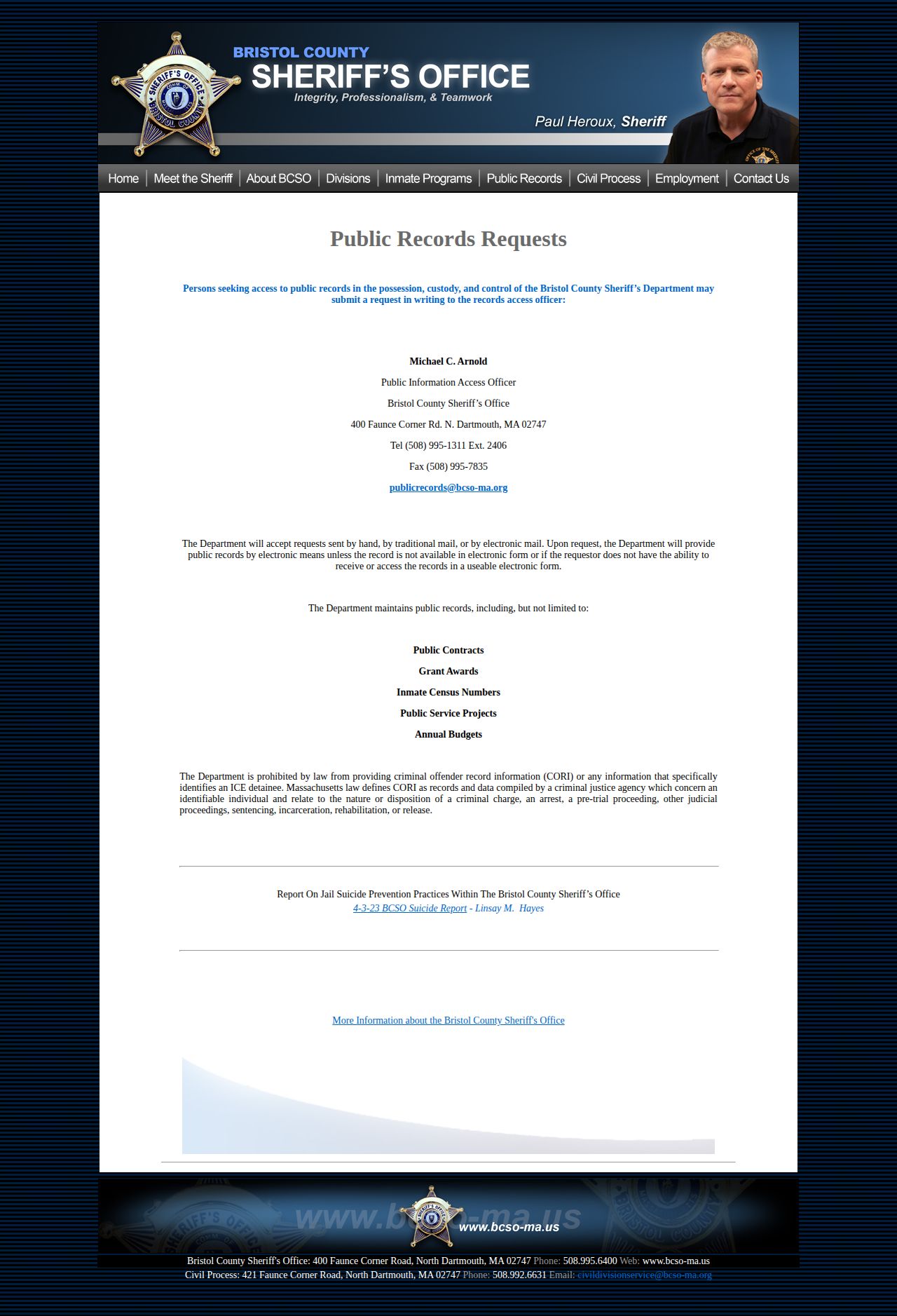
The records route preserves a way to seek an underlying item after a web check fails, but it is not a rapid public release feed.
Bristol County Release Data Has No Roster
Bristol County's no-feed status is unusually complete. There is no named roster, three-day archive, photo gallery, or official mobile application for custody lookup. BCSO's social links carry agency news rather than person-level jail data. No published feed retention period exists because no named feed is offered.
Underlying records can outlast the web evidence. The statewide retention schedule calls for House of Correction files to remain 25 years after release and inmate photographs for 10 years until superseded, subject to access restrictions. Retention does not guarantee disclosure. It does show why absence from the public web is not the same as absence of an administrative record.
The same distinction applies to monthly admission and release summaries. A schedule may allow an aggregate report to remain only while it has administrative value, while the underlying House of Correction file lasts much longer. Ask for an existing record by its likely date and type. If BCSO says no record exists, ask whether the answer reflects retention, a different custodian, or a request that would require creating a new report.
Massachusetts CORI rules also explain why a retained record may not be open to every requester. A person seeking their own information has an authorized personal-record route. A general requester can still ask for policy, aggregate data, or a segregable nonexempt field, but should expect a written restriction on identifiable release data. The public court docket remains a separate source governed by court access rules.
Bristol County Moves in 72 Hours
The three-day window must account for Bristol's facility layout. Ash Street serves regional and pretrial functions in New Bedford. The main jail, Women's Center, and separately inspected Modular Building share the Dartmouth campus and BCSO authority. A move between those buildings is not a release, even if one facility's count falls.
The state inspection listings show the four facilities as distinct entries. That supports asking BCSO for the exact unit while avoiding the false claim that each has a separate release database.
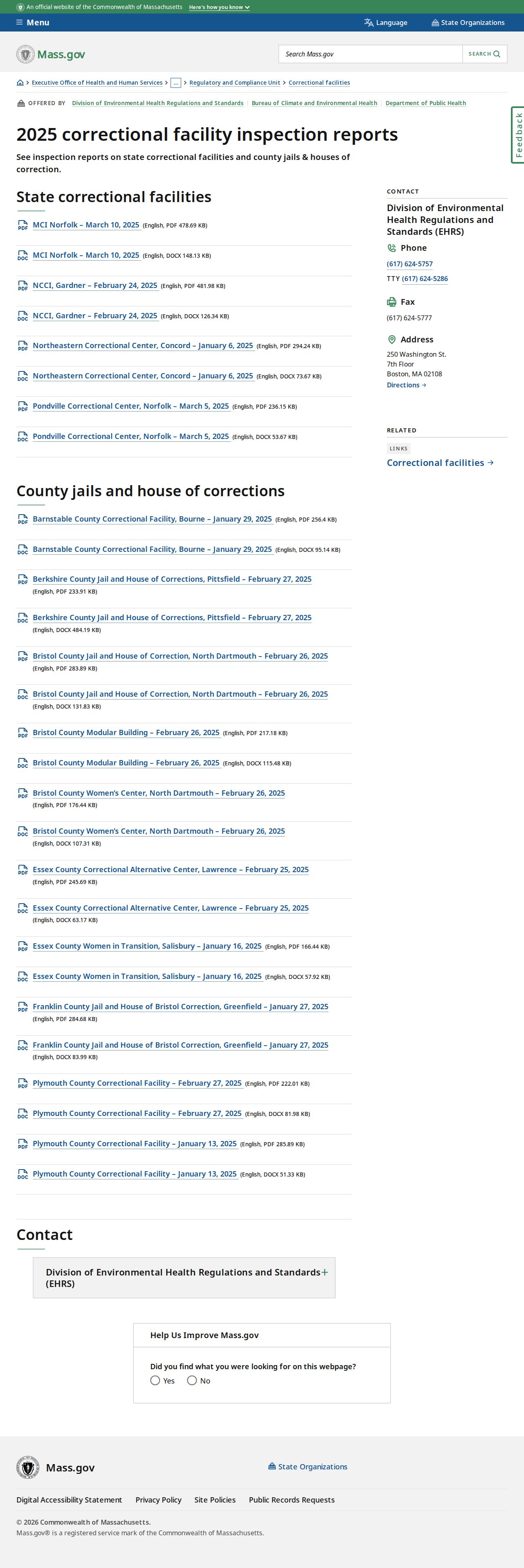
The separate listings explain local movement, but the court and BCSO record still control whether a person was discharged or transferred.
For a same-day event before the wider window is needed, the Bristol County 24-hour release check focuses on today's bail and processing sequence.