
Bristol County Parole Versus Probation
Parole is conditional release from confinement for the unexpired part of a sentence. The Massachusetts Parole Board issues the permit and generally keeps jurisdiction through the maximum term unless parole ends earlier. Probation is imposed by a court and supervised through the Massachusetts Probation Service. A person may complete a Bristol house-of-correction term and start probation without ever being on parole. Another person may leave state or county custody on parole. Some cases can involve both at different times.
| Point | Parole | Probation |
|---|---|---|
| Legal source | Massachusetts Parole Board permit | Trial Court order |
| Relation to confinement | Follows release from a custodial sentence | May follow confinement or be imposed without it |
| Local record path | Authorized Board file, public life decision when applicable, and docket | Docket, subject file, or signed authorization |
| Public name lookup | No general statewide parolee search | No statewide public probationer search |
| How it ends | Maximum term or earlier Board termination | Court-ordered end date, subject to lawful change or credit |
A docket label saying “probation” does not place the person in VINELink. A VINE release event also does not reveal every later condition. Use the source that owns the supervision status.
- Parole
- Release under a Board permit while part of the sentence remains.
- Probation
- Court-ordered community supervision through the Probation Service.
- Absconder
- A person alleged to have left supervision without authorization; it is an official status, not a rumor.
- Revocation
- A formal process that may cancel parole after an alleged post-release violation.
- Rescission
- Board review of a positive parole vote before physical release occurs.
- Discharge
- The lawful end of the relevant supervision status.
Verify Bristol County Release Supervision
Neither agency will confirm another adult’s status simply because a caller is a relative, friend, spouse, neighbor, or concerned member of the public. Probation requires the subject’s request or a properly signed authorization before a defined disclosure can be reviewed and redacted. The individual parole-record route follows the same authorization principle. Public life-sentence decisions are a limited exception, not a substitute for a statewide registry.
- Identify the originating court and exact docket number from the release paperwork, arrest record, or known case.
- Read the chronological docket for sentence, probation order, violation, surrender, disposition, and later supervision events.
- Use a public life-sentence Record of Decision only if the matter falls in that published Board category.
- Have the subject request the probation or parole file, or complete the proper limited authorization for a third party.
- Confirm physical release separately through the custodian because a probation order or positive parole vote does not prove the person left custody.
The MassCourts eAccess portal is the public starting point for a Bristol criminal docket.
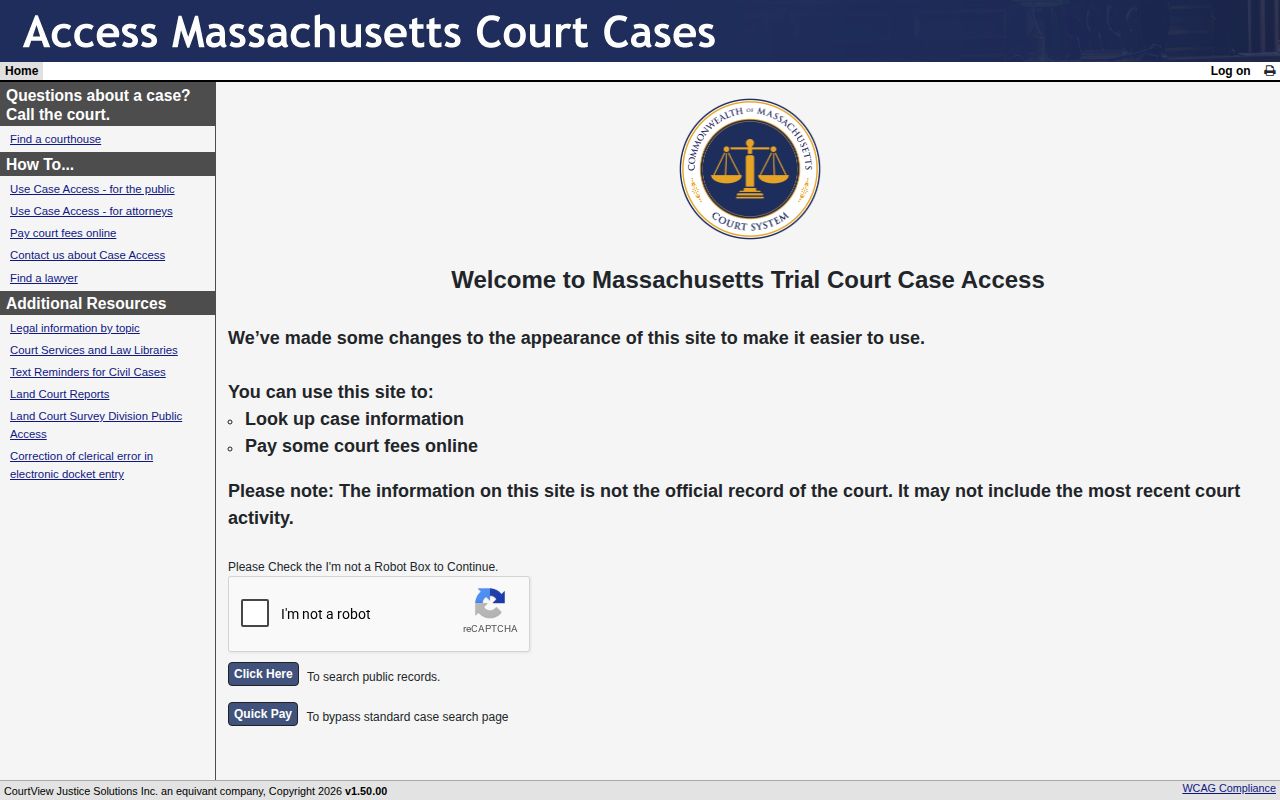
The docket can show a court’s probation order or violation event, but it does not make confidential agency notes public.
Bristol County Parole Region 8
Parole Region 8 is the current Bristol-area supervision office. Its live state page lists 421 Faunce Corner Road, second floor, Dartmouth, MA 02747; 508-995-6400 extension 3640; and weekday hours from 9 a.m. to 5 p.m. A broader state location listing has carried a temporary-address or alternate-number variation, so check the live office page before visiting.
421 Faunce Corner Road, 2nd Floor
Dartmouth, MA 02747
508-995-6400 ext. 3640
Monday-Friday, 9 a.m.-5 p.m.
The official Parole Region 8 page provides the current Bristol supervision contact.
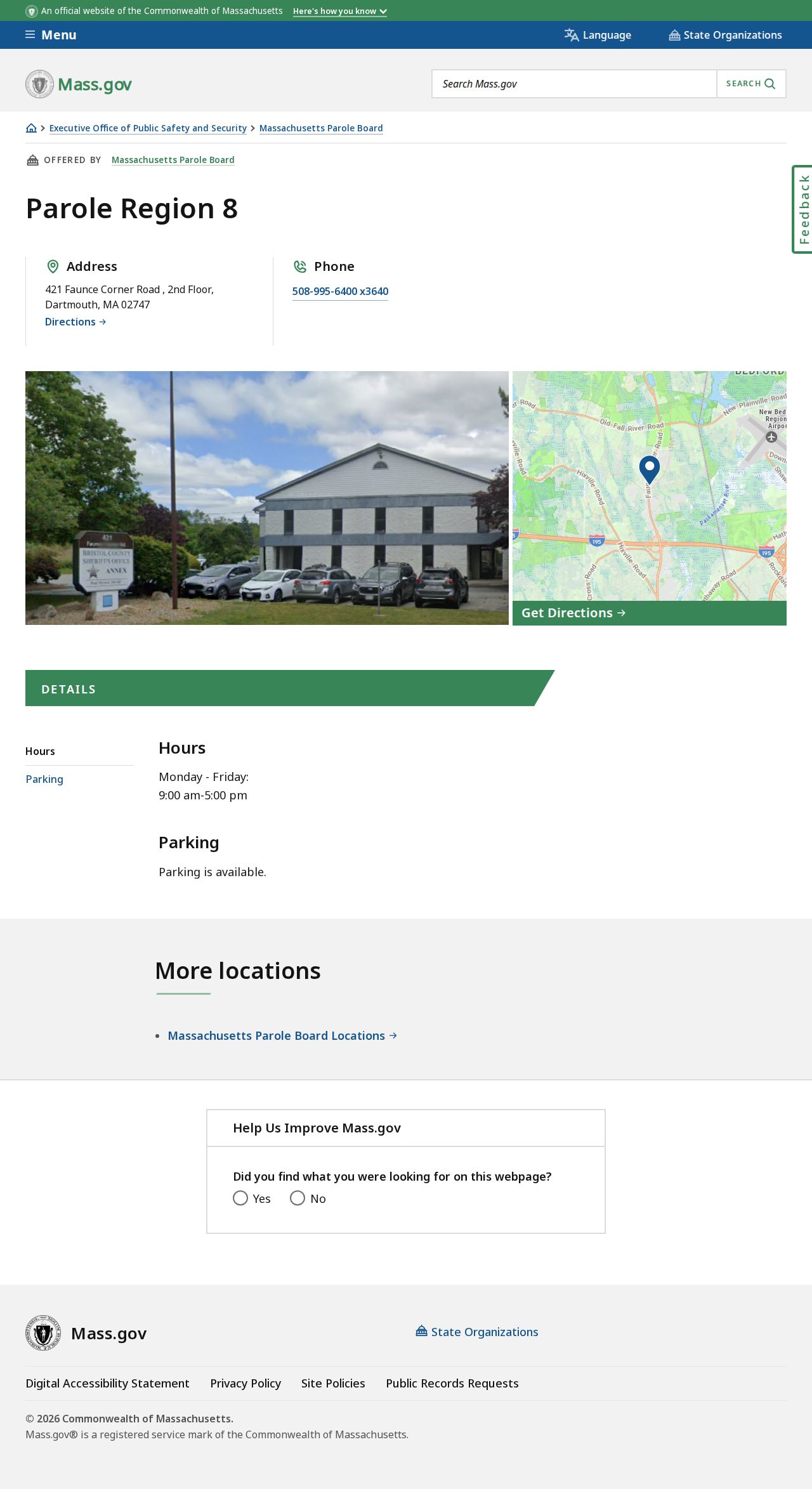
Region 8 is a supervision office, not a public database that confirms whether any named adult is on parole.
Central Parole Board records and hearing contacts are at 12 Mercer Road, Natick, MA 01760, 508-650-4500 or 866-480-6272, weekdays from 8:45 a.m. to 5 p.m. Individual records still require the proper authorization.
Bristol County Probation Record Access
Adult probation information is confidential unless the subject requests it or permits a defined disclosure through a signed release. The supervising probation officer may explain the subject-access process and assess what can be provided. Court-specific probation contacts appear on the official courthouse location pages. The Office of the Commissioner of Probation is at 1 Ashburton Place, Room 405, Boston, MA, 617-727-5300, weekdays from 8:30 a.m. to 4:30 p.m.
The official probation information access page explains confidentiality, subject requests, and signed authorization.
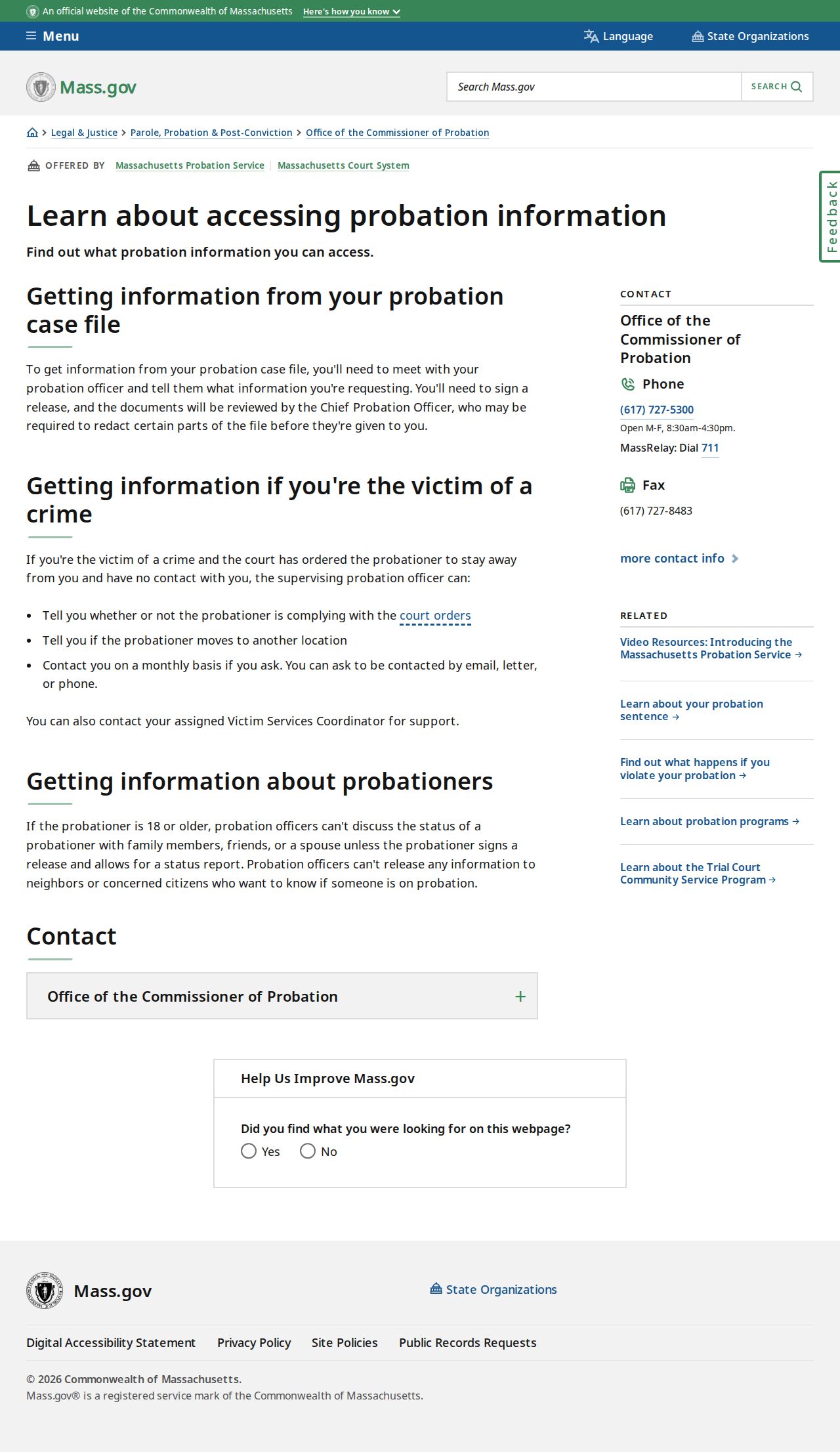
The access rule prevents a local office from being used as an informal name lookup.
Community Justice Support Centers at 867 State Road in Dartmouth, phone 508-717-0601, and 5 Cohannet Street in Taunton serve eligible people in the community. They are reporting and service resources. They are not public probationer search systems.
Note: Use the court listed on the docket because Bristol probation contacts differ among Attleboro, Fall River, New Bedford, Taunton, and Superior Court.
Bristol County Parole Hearing Records
The Massachusetts Parole Board’s hearing system includes institutional, life-sentence, victim-access, clemency, and termination matters. Institutional release, rescission, and revocation hearings are closed. Life-sentence hearings and most Central Office proceedings are public, while Victim Access Hearings are not. The hearing type controls both access and what the event can prove.
A positive vote authorizes parole subject to prerequisites and conditions. It is not the physical release record. Possible destinations include Massachusetts field supervision, interstate supervision, another state or federal sentence, ICE, or another correctional institution. A denial means no permit was issued then. A deferment is not a grant. Rescission concerns a prior positive vote before release, while revocation addresses an alleged violation after release.
The Massachusetts Parole Board hearing hub defines the hearing types and public-access boundaries.
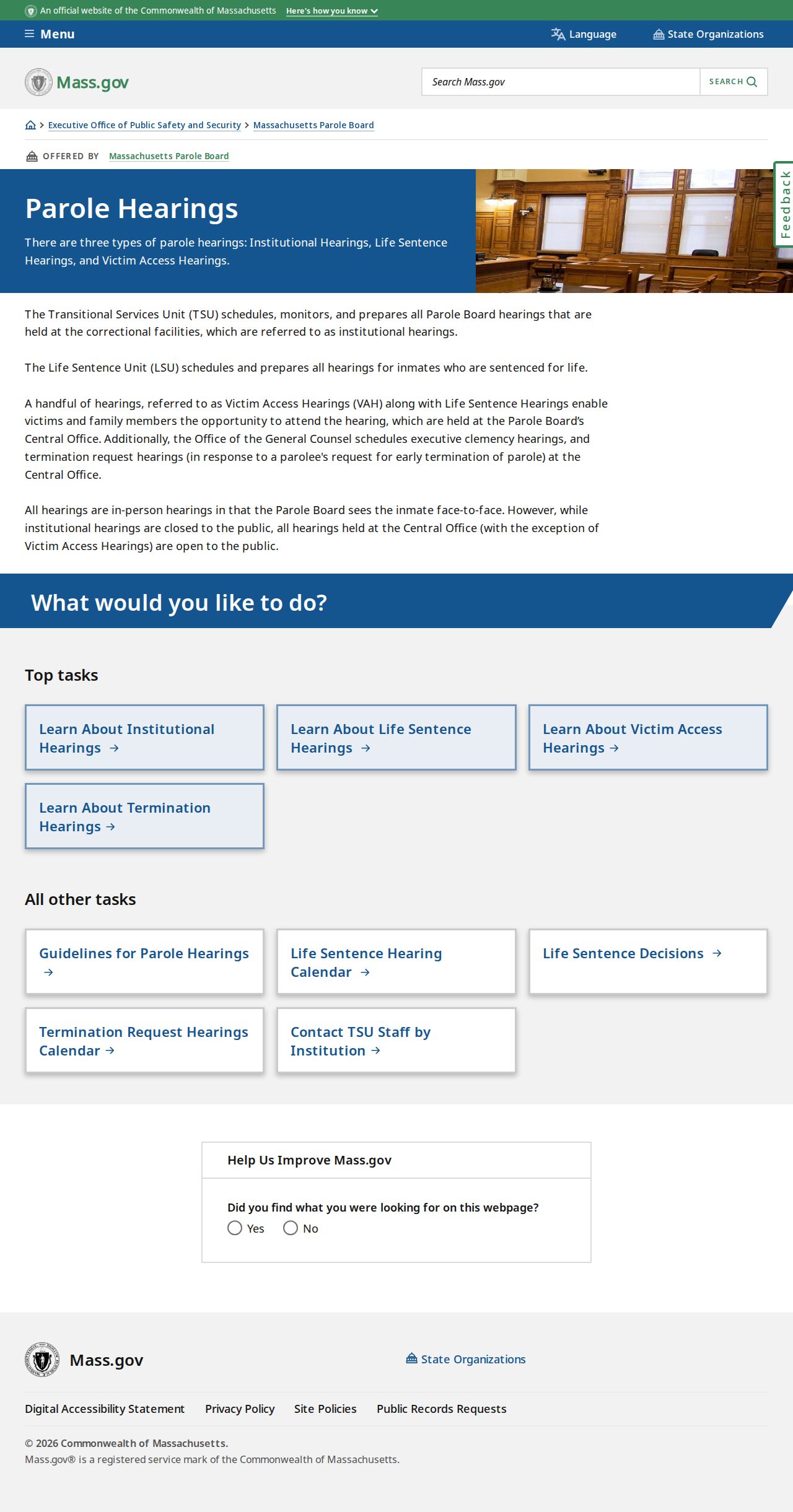
The distinctions keep a scheduled hearing or positive vote from being reported as a completed Bristol County release.
Bristol Parole Decisions and Calendars
The public life-sentence Records of Decision are arranged by hearing year and last name. They may state grant, denial, reserve or defer, prerequisites, conditions, reasons, and the next review. This set is the Board’s main public person-specific result source, but it does not cover every term-sentence parole matter. Most other individual records require authorization.
The life-sentence decisions index supplies public Board outcomes for that limited case class.

A decision must be read for its own result and conditions, not used to predict another person’s release.
Life-sentence hearing calendars are posted monthly and can show date, time, name, commitment number, facility, and initial or review type. A calendar entry predicts a hearing only. Parole termination calendars are also published in monthly or periodic files and address early termination of supervision rather than initial release from jail.
The termination request hearing calendar is the official public schedule for those proceedings.
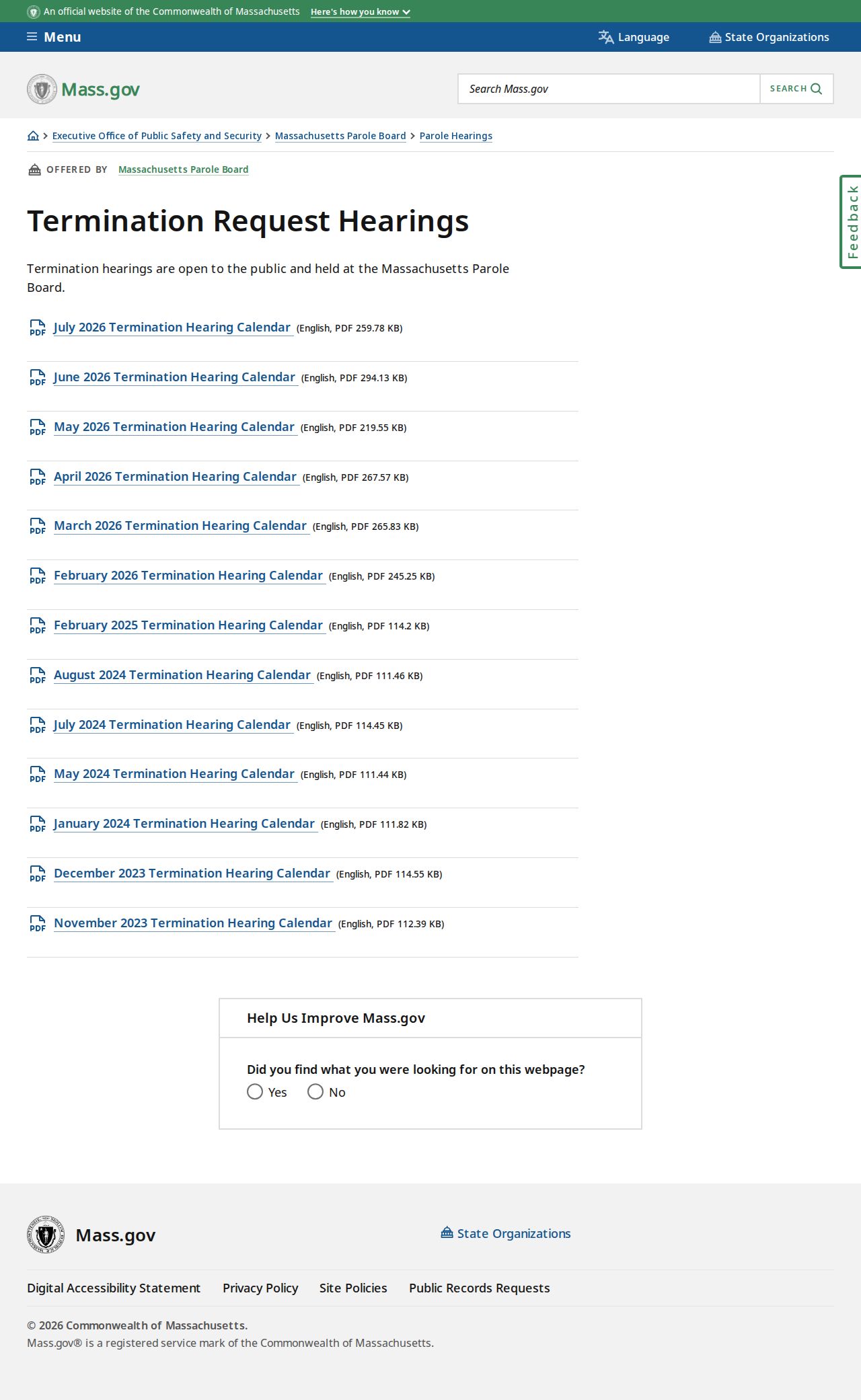
A listed termination hearing does not mean that parole has ended; the later Board outcome controls.
Bristol County Release Warrants
No official public Bristol County parole or probation absconder list was found. Do not treat a missed appointment, social post, or third-party claim as official status. A public docket may show a violation, surrender, or warrant event, but any current custody claim should be confirmed through the court or responsible authority.
A BCSO code stating “to warrant” means release to another authority under Massachusetts’ release categories. It does not mean community freedom. Follow the record to the next court or custodian. VINELink also has limits here: it covers participating MA DOC custody changes, not every probation condition or Bristol jail event.
Ending Bristol County Release Supervision
Parole usually continues through the sentence maximum unless the Board ends it sooner. A termination calendar entry is only a scheduled proceeding. The decision or authorized record shows the result. Under the ordinary state-prison framework, parole eligibility begins after the court-set minimum as affected by allowed deductions, while Board jurisdiction generally runs to the maximum. Life-sentence rules have separate exclusions, hearing, and voting requirements.
Probation ends under the court’s order and governing law. Compliance credits under M.G.L. c.276, §87B may affect certain eligible probation end dates after incarceration. They do not change the earlier physical jail release date. A discharge record, court docket, or authorized agency file is stronger proof than an assumed end date.
The full Bristol custody and release chain, including BCSO, court, DOC, federal, and immigration sources, appears on the Bristol County released inmates search.
Bristol County Reentry After Release
Project ROAR and Bristol’s reorganized post-release services offer BCSO case management before and after release for up to one year. They can assist with health continuity, transportation, documents, and case coordination. These resources may operate alongside parole or probation, but participation does not by itself establish that a person is under either form of supervision.
Use Region 8 for parole supervision matters, the owning court and Probation Service for probation, and BCSO reentry channels for documented service navigation. Keeping those roles separate helps a released person reach the correct office without asking a service center to disclose confidential status.
Property After Bristol County Release
The BCSO property rules say original incoming legal or privileged papers are provided at discharge or earlier with written authorization. Personal property pickup is appointment-only on weekdays, with no weekend or holiday exchanges. Unclaimed property is disposed of 30 days after release. The published appointment line is 508-995-6400 extension 2411.
Call promptly and name the last known Bristol facility or unit. An internal move between Dartmouth buildings can affect where the property is held, and that move should not be mistaken for release. Property pickup is a separate administrative process from parole, probation, and release-record verification.
Note: The 30-day property deadline can run while a person is arranging supervision, transport, identification, and other immediate reentry needs.